

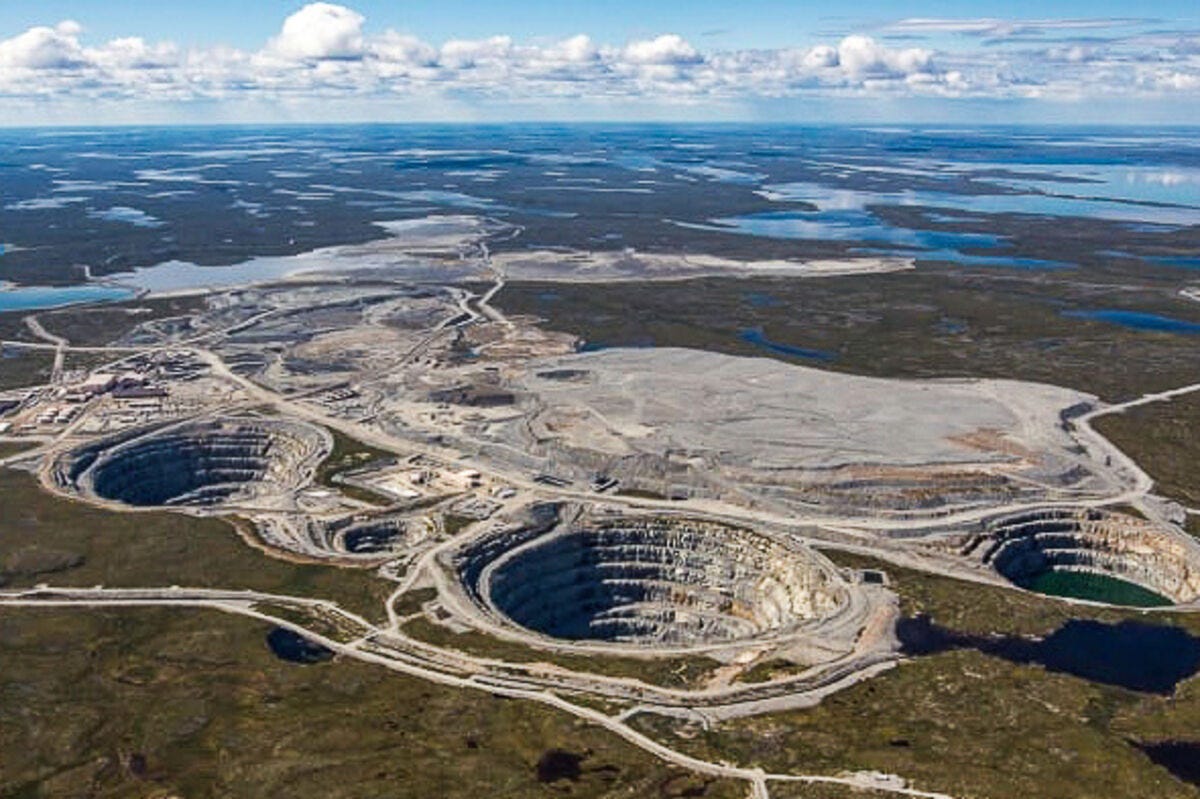
The Northwest Territories pulled one of the world’s great mineral fortunes out of the ground. Most of the wealth left with the stones. The mines are closing now. When the next boom comes, the Indigenous nations whose homelands make it possible should not be hired hands on somebody else’s asset. They should be owners—together.
The Last Truck
On a cold March morning in 2026, the last haul truck rolled out of the Diavik diamond mine and did not come back. For more than two decades, the mine had been a small city carved into the Canadian Shield, a place where men and women from Yellowknife and Behchokǫ̀ and Inuvik and Fort McPherson had gone to work, to earn, to build something. The diamonds they pulled from the ground were shipped south and sold in Antwerp and Tel Aviv and Mumbai. The money they earned stayed, for a while, in the North.
Now the mine is quiet. Ekati, the territory’s first diamond mine, went into receivership and shut down abruptly, laying off about 360 people with little warning. Gahcho Kué, the last one standing, is preparing to wind down by 2028. The question is no longer academic and it is no longer safely in the future: after twenty-five years of diamonds, what is still here because the diamonds were here?
Diamonds have always been sold on permanence. In 1947, a young copywriter named Frances Gerety handed De Beers what may be the most successful advertising line ever written: A diamond is forever. Anyone who has ever built a budget around a mine knows the half of the slogan that never made the billboard. A diamond is forever. A diamond mine is not. Every mine is born with an expiry date, and the only question that matters is what you build during its working life that will still be standing when it’s gone.
Participation Was Never Ownership
I did not watch the diamond years from a university, a ministry or a consulting office. For fifteen years I was the chief financial officer of an Indigenous development corporation in the Northwest Territories. I lived in the arithmetic behind the speeches: cash flow, boards, lenders, payroll, contracts, investment decisions and the consequences of each. We were never one of the big diamond suppliers. The trucking, camp and site-services work went largely to the development corporations of the nations that had signed impact benefit agreements with the mines. I watched from the next table over: close enough to see the work, far enough to see the structure.
What those corporations built was real. They ran trucking fleets, built roads, staffed camps, trained workers and built companies that could compete. They made money. They built capacity. The failure was not theirs. They became very good at the role the system rewarded: supplier, contractor, employer. The role was too small. They were paid—often well—to help extract a fortune they did not own.
The question the North should have asked from the first truckload is brutally simple: When the mine is gone, what do we own? Indigenous people participated in the diamond boom. They worked it, supplied it, hauled it, fed it, built for it and learned from it. Participation was never the missing piece. Ownership was. The next boom should end differently: Dene, Métis and Inuvialuit nations—with settled claims or without them—should own it together. Not as an afterthought. Not as a procurement category. On the cap table.
A Long Line of Booms
To understand how the North got here, you have to go back further than the diamonds.
The Pattern Before Diamonds
The Northwest Territories has been bought, sold and struck rich more often than most places have held elections. In 1870, after the Hudson’s Bay Company accepted £300,000 to surrender its charter, Britain handed Rupert’s Land and the North-Western Territory to the young Dominion of Canada. It was one of the largest land transactions in history, and nobody thought to ask the people who lived there.
From then on, the pattern held: someone found something valuable in the ground, and a treaty arrived close behind. The Klondike gold rush brought Treaty 8 in 1899. Imperial Oil struck oil at Norman Wells in 1920, and Treaty 11 was signed the following summer. Ottawa understood those treaties as land surrenders. The Dene understood them, and still do, as agreements to share the land and live in peace. That gap in interpretation has kept northern lawyers gainfully employed for a century.
Uranium from Port Radium, on Great Bear Lake, found its way into the Manhattan Project. Yellowknife’s Giant Mine produced roughly seven million ounces of gold over half a century and left behind 237,000 tonnes of arsenic trioxide dust sealed underground. The gold went south. The arsenic stayed, and under the remediation plan it will be kept frozen in the ground indefinitely, at public expense. In budgeting terms, “indefinitely” is a very long time.
The economic historian Harold Innis had a name for this pattern. In The Fur Trade in Canada (1930), he described a country organized from the start around shipping raw staples to distant markets, leaving its hinterlands at the mercy of prices and decisions made somewhere else. He also wrote a sentence that deserves a place above the door of every territorial ministry: “We have not yet realized that the Indian and his culture were fundamental to the growth of Canadian institutions.” Nearly a century later, the realization is still a work in progress.
By the 1970s, the people of the North had stopped waiting for it. When Justice Thomas Berger travelled the Mackenzie Valley to hear what communities thought of a proposed gas pipeline, he came back with a recommendation the industry did not want to hear: wait ten years and settle the land claims first. “The North is a frontier,” he wrote in his 1977 report, Northern Frontier, Northern Homeland, “but it is a homeland too.” The pipeline wasn’t built. The claims, eventually, were.
So when the geologists Chuck Fipke and Stewart Blusson announced in 1991 that they had found diamond-bearing kimberlite near Lac de Gras, setting off the largest staking rush in Canadian history, the North was ready to negotiate. Ekati opened in 1998 as Canada’s first diamond mine. Diavik followed in 2003, Snap Lake in 2008 and Gahcho Kué in 2016. This time, the mines signed impact benefit agreements with Indigenous governments and socio-economic agreements with the territory. This time, the people of the land had a seat at the table.
They had a seat at the table. They were still not on the cap table. That distinction is the whole story.
What the Mines Built
Credit where it is due: the diamond-era agreements built real things.
Between 1996 and 2023, the Lac de Gras mines spent $27.7 billion on the goods and services that kept them running. Roughly 70 cents of every one of those dollars went to northern businesses, and nearly a third of the total, about $8.6 billion, went to Indigenous-owned firms.
The jobs followed the money. Over the same period, the mines generated more than 74,000 person-years of work. Nearly half went to Northerners, and half of that to Indigenous Northerners. At its peak, diamond mining accounted for more than a fifth of the territory’s entire economy. Even in the slump of 2023, it still produced about one dollar in every seven.
The Capacity Was Real
The Indigenous development corporations were not bit players in this story; they were the backbone of the supply chain. In 2023 alone, three of them—the Tłı̨chǫ Investment Corporation, the Yellowknives Dene’s Det’on Cho Group and Metcor—earned $104 million from the mines and supported 355 Indigenous jobs paying $39.6 million in wages in Yellowknife, Dettah, Ndilo and the Tłı̨chǫ communities. That money built housing, a community freezer and logistics operations that now reach into Nunavut and Saskatchewan.
Further north, the Inuvialuit took a different road to a similar destination. They were never direct partners in the diamond mines. Instead, they used the settlement from their 1984 land claim to build a diversified group of companies. For the fiscal year ending December 2025, the Inuvialuit Regional Corporation reported record earnings of $137.9 million on assets of nearly $2 billion. This year it paid each eligible beneficiary about $1,700, up 27 percent, bringing its total distributions past $90 million.
The development corporations did what they were built to do, and many did it exceptionally well. The weakness was the bargain around them. Much of what they built depended on customers with expiry dates. The next generation of agreements has to build assets that remain when the customer leaves.
Some of that is geology; mines run out. Some of it is the market. Lab-grown stones, chemically identical and a fraction of the price, have dragged natural diamond prices sharply lower, and even De Beers’s own parent company has been trying to sell it. A diamond, it turns out, is forever mainly in the jewellery store.
The Warning Was There
None of this should have surprised anyone. In December 2018, a briefing prepared for the NWT Indigenous Leaders Economic Forum, a gathering of Dene, Métis and Inuvialuit leaders in Yellowknife, warned that “the territorial economy is in some trouble” and that a significant downturn in mining was coming within five years. It pencilled in Diavik’s closure for 2024-25, missing by about a year, and named an early Ekati shutdown as the worst case. “Make no mistake,” it said, “this scenario would leave the NWT economy in serious trouble.” The leaders in that room didn’t respond by asking for a new program. They started organizing to invest.
The warning was repeated from the economic side in 2023. In Eyes Wide Open, Yellowknife economist Graeme Clinton argued that the conversation about life after oil and diamonds “should have started the day Ekati mine produced its first diamond almost 25 years ago.” Using 2019 as a baseline, his deliberately hypothetical scenario for the disappearance of the resource sector put the exposure at $2 billion in output, 3,460 jobs and an estimated 1,100 residents lost through out-migration. It was not a forecast, and he said so. The point was harder to dismiss: by 2023 the cliff was visible. The North was no longer being surprised by geology; it was being surprised by a calendar.
A year later, the forum’s chair, Darrell Beaulieu, summed up the diamond era better than any economic impact study: southern companies “come to the NWT, make their profits and then they are gone, while the Northern Indigenous companies are still here.” Still here is not a consolation prize. It is leverage. The companies leave. The nations do not. The next question is whether the permanent people will own the permanent assets—or again send invoices to whoever does.
What the Government Kept
The Government of the Northwest Territories (GNWT), meanwhile, was in a different line of work: collecting the rent. Or trying to.
Devolution Did Not Mean Ownership
For the first eighteen years of the diamond era, the royalties didn’t go to Yellowknife at all. They went to Ottawa, which controlled Crown land and resources in the North. That changed with devolution in 2014, which the territorial government sold on two promises: decisions about the North would finally be made in the North, and resources would become a “significant source of new revenue.”
The fine print was less thrilling. Ottawa effectively claws back half of the territory’s resource revenue through its federal transfer and caps how much the territory can keep. Of the half that stays, a quarter goes to the Indigenous governments that signed on to devolution. Net result: for every dollar companies pay to develop resources on public land, the GNWT keeps about 37.5 cents, Indigenous governments receive 12.5 cents, and the rest heads south. Devolution, in other words, handed the North the keys and kept half the gas money.
In the good years after devolution, that came to about $60 million a year in total: more than $20 million for the territory and at least $7 million for Indigenous governments. Then the floor gave way. In 2023-24, the GNWT collected $5.7 million in resource revenue. In 2024-25, after accounting adjustments, the figure came in below zero, a feat of public finance that deserves its own award. The forecast for this year and next is less than $1 million a year.
The North Saved Almost Nothing
The territory’s savings account tells the same story. Contributions to the NWT Heritage Fund started at $250,000 a year, rose above $5 million a year after devolution, and have now, in the words of Frame Lake MLA Julian Morse, “fallen off a cliff.” The fund is worth tens of millions of dollars. Alberta’s Heritage Savings Trust Fund, hardly a model of discipline given that the province stopped making regular resource deposits in 1987, is still worth hundreds of times more. Peter Lougheed, the premier who created it, liked to tell Albertans to “think like owners.” Yellowknife thought like a tenant: grateful for the heat, uninterested in the deed.
Put the numbers side by side and the result is almost comic. The diamond mines shipped well over $30 billion worth of stones out of the North. On the most generous accounting, the territorial government’s total revenue from them will not exceed $1 billion. That is about three cents on the dollar.
Resource economists will point out, correctly, that government take is properly measured against profits rather than sales, and that much of the public share went to Ottawa rather than Yellowknife. Fair enough. Run the numbers any way you like. You will not find a version in which the North captured the real prize: not the wages and invoices for digging the diamonds up, but the value of the diamonds themselves.
Ottawa wrote much of the rulebook, and the GNWT negotiated devolution from a weak hand. That explains how the arrangement happened. It does not change what the arrangement produced. A depleting asset came out of northern ground, and too little of its value was converted into assets that would keep earning for northern people after the mines closed.
Michael Hudson has spent much of his career trying to drag an old economic idea back into modern conversation: economic rent—the income that comes from controlling scarce land, natural resources, monopolies or financial claims rather than from producing more of something. You do not have to buy Hudson’s whole politics to see why the distinction matters in a resource economy.
Mining companies supplied capital, technology, management and risk, and they were entitled to earn a return for doing it. But the diamond itself was formed in the Earth’s mantle long before any company, regulator or territorial government arrived. The enduring question is who captures the value of the finite resource underneath all that productive effort. In the diamond era, too much of that value left with the stones.
Who Actually Holds the Cards
If ownership is the prize, stop asking only who has jurisdiction and ask who has leverage. Every major northern project depends on Indigenous land, rights, consent, access, people and political legitimacy. That is not symbolism. It is bargaining power. A modern land claim changes the legal machinery; it does not create the underlying fact.
Rights Are Leverage
The real economic power in the Northwest Territories therefore does not sit only in Yellowknife. It sits with the Indigenous nations whose homelands the projects cross. In 1975, the Dene declared that they “insist on the right to be regarded by ourselves and the world as a nation.” Chief Gerald Antoine put the principle even more plainly at the 2019 forum: “we are the original people in this land and rights flow from this fact.” Note what he did not say. Rights do not begin with a ratification vote, a federal news release or the completion of a negotiating table. They flow from the fact.
Some nations have written those rights into modern land claims. The Inuvialuit settled first, in 1984, with about 91,000 square kilometres of land, roughly 13,000 of them with subsurface rights. When a territory-wide Dene-Métis agreement collapsed in 1990, the Gwich’in and the Sahtu Dene and Métis negotiated their own, in 1992 and 1993; the Gwich’in deal alone included more than 6,000 square kilometres of subsurface mineral title. The Tłı̨chǫ Agreement, signed in 2003 and in force since 2005, gave the Tłı̨chǫ ownership of 39,000 square kilometres, subsurface included.
Settled or Unsettled
Others, including the Akaitcho and Dehcho Dene, are still negotiating, some since before many of their citizens were born, a failure Ottawa and Yellowknife share. Their rights are not suspended while the paperwork drags on. Section 35 of the Constitution protects existing Aboriginal and treaty rights, and in 2014 the Supreme Court of Canada recognized Tsilhqot’in Aboriginal title over land in British Columbia that no historic treaty had surrendered. A modern agreement can clarify rights, jurisdictions and title. It does not manufacture an Indigenous nation’s relationship to its homeland from scratch.
Yet the operating habit of northern resource development still too often puts Indigenous governments in the stakeholder box: consult them, accommodate them, negotiate benefits with them. The leaders named the problem years ago. The central conclusion of their 2018 forum was that Indigenous governments should move from being stakeholders to becoming leaders and decision-makers in the territorial economy. When Dene National Chief George Mackenzie later called for mandatory Dene equity in major projects, the GNWT replied that equity and governance arrangements depended on the individual project and the parties involved. That is precisely the smaller frame the leaders were rejecting. A stakeholder gets consulted. An owner gets a vote.
That is the line this essay draws. Land-claim status changes the legal mechanics of a deal; it should not decide who gets to be an owner. Settled or unsettled, every Indigenous nation in the Northwest Territories should be inside the ownership strategy for the next generation of major projects. The task is to turn rights, consent, land, capital and collective bargaining power into equity. That is where constitutional principle becomes a balance sheet.
Contractors, Not Owners
Why did twenty-five years of agreements produce excellent contractors and so few owners? Because we kept confusing economic activity with economic power.
Count Equity, Not Just Activity
For a quarter-century we counted everything that could fit in an annual report: jobs, person-years, training seats and procurement dollars. Those things mattered. We should have counted one more thing: equity. Jobs tell you who worked during the boom. Ownership tells you who will still be earning after it.
The clearest example was rebuilt every winter out of ice. The diamond mines formed a coalition of their own to share the cost of the winter road to Lac de Gras, which, as the 2019 forum heard, ran $25 million to $30 million a year. Jason Snaggs pointed out the obvious: over twenty years, an Indigenous coalition could have built a permanent road through the Slave Geological Province and charged industry and government a toll to use it. Instead, every spring, the investment melted. The mining companies understood the value of a coalition. The territory’s development policy never quite caught up.
For more than three decades, Stephen Cornell and Joseph Kalt of the Harvard Project on American Indian Economic Development have studied why some Native nations prosper while others with similar resources stagnate. Their answer has held up across hundreds of nations: sovereignty matters, institutions matter and culture matters. What they call the standard approach (bring in outside projects, count the jobs and income, let someone else make the strategic decisions) produces bursts of activity and very little lasting development.
What works is what they call nation building: real decision-making power, exercised through capable institutions that fit the community’s own values. In the Harvard Project’s words, “When Indian tribal governments make their own decisions about what development approaches to take, they consistently out-perform external decision makers.” Chief David Etchinelle made the same point at the 2019 forum in a single sentence: “we want to make the decision for our own communities and for our own people.” Three decades of research, one sentence.
Ownership Still Requires Governance
For fifteen years I watched the governance question from inside an Indigenous development corporation, and I do not romanticize it. Ownership can be squandered by weak boards, political interference and bad capital allocation just as surely as any other asset. At the Royal Commission on Aboriginal Peoples’ 1993 economic round table, Joseph Kalt reported that, across a sample of tribal enterprises, the odds of profitability were about five times higher when an independent management board was separate from the tribal council. The arithmetic has aged better than most management fashions. Elected leaders owe their voters good government; directors owe the enterprise a fiduciary duty. When those roles blur, profitability can bleed out one favour at a time. Indigenous ownership needs governance strong enough to survive an election cycle.
That is why the answer to bad community ownership is not less community ownership. It is better governance. Chief Gerald Antoine described the old Dene economy at the 2019 forum as one based on “only take what you need, not taking what you want.” That is not nostalgia. It is a rule about stewardship, and durable ownership always depends on rules.
Elinor Ostrom spent her career documenting exactly that. Studying fisheries, forests and irrigation systems around the world, she found that communities routinely manage shared resources well—often better than distant governments or absentee owners—when the people who live with the rules help make them and institutions make responsibilities clear. In her Nobel lecture she argued that “a core goal of public policy should be to facilitate the development of institutions that bring out the best in humans.” The North already has the communities. The work is to build institutions worthy of the assets they will own.
The 2024 economics Nobel went to Daron Acemoglu, Simon Johnson and James Robinson for work centred on a related distinction: inclusive institutions distribute power and opportunity broadly enough that people have a reason to invest; extractive institutions concentrate control and route the gains elsewhere. The language fits the diamond story uncomfortably well. Indigenous Northerners were included in the work. They were not included enough in the ownership.
If that sounds idealistic, it shouldn’t. Other resource economies faced the same choice and built ownership into the model.
How Others Got It Right
Alaska learned its lesson the expensive way. In 1969, after the Prudhoe Bay discovery, the state auctioned North Slope oil leases and raised $900 million in a single day, then spent most of it within a few years. Chastened, Alaskans amended their constitution in 1976 to create the Alaska Permanent Fund, championed by Governor Jay Hammond, a former bush pilot and trapper who later titled his memoir Tales of Alaska’s Bush Rat Governor. Since 1982, every resident has received an annual dividend from the fund’s earnings.
Economists expected the cheques to make people work less. A study in the American Economic Journal: Economic Policy found no effect on employment and a 17 percent increase in part-time work. Cash in people’s pockets creates demand, and demand creates jobs. Alaskans now argue every year about the size of the cheque, which is exactly the kind of argument you want to be having.
Norway struck oil in the North Sea that same year and made a series of decisions that look obvious only in hindsight. In the early 1970s, its parliament endorsed what became known as the “ten oil commandments,” insisting on national control and that petroleum benefit society as a whole. It created a state oil company, eventually set a marginal tax rate on petroleum profits of 78 percent, and the oil companies kept showing up anyway.
Part of the credit belongs to an unlikely architect: Farouk al-Kasim, an Iraqi geologist who moved to Norway in 1968 and helped design its petroleum regime, having seen at home what oil can do to a country that manages it badly. Since 1996, Norway has deposited its oil revenue into what is now the Government Pension Fund Global and limits itself to spending roughly the fund’s expected real return, about 3 percent a year. The fund is worth on the order of two trillion US dollars and owns roughly 1.5 percent of every listed company on Earth. Norwegians did not become dependent. They became rich.
Botswana is the most striking case, because it started so poor. At independence in 1966, it was among the poorest countries on Earth, with barely a dozen kilometres of paved road. Diamonds turned up at Orapa the following year. Rather than hand the mines to a foreign company and collect a cheque, the government went into partnership with De Beers, and it didn’t start with half. It began with a minority stake and, when the enormous Jwaneng deposit was discovered, went back to the table and came away with 50 percent of what became Debswana.
Diamonds have since paid for roughly a third of the government. A deal struck in 2023 extends the mining licences to 2054 and lifts Botswana’s share of rough diamond sales toward half over the next decade. Botswana is not immune to today’s diamond slump, since no producer is, but it faces the downturn as an owner, not as a contractor waiting for the phone to ring.
Closer to home, the Haisla Nation on British Columbia’s north coast owns 50.1 percent of Cedar LNG, a multibillion-dollar project billed as the first Indigenous-majority-owned LNG export facility in the world. The Haisla didn’t ask for a grant. They borrowed against future cash flow and bought in, taking on up to $1.4 billion in debt to finance their stake. “It was viewed by our people as, ‘we can either jump on board, or we can get off and leave it and get left behind,’” Chief Councillor Maureen Nyce has said.
The turning point came when the Nation’s business development officer, Dave LaVallie, urged council to look past direct payments from LNG Canada and secure access to pipeline capacity, the one asset that let the Haisla build a terminal of their own. The project will create about 100 skilled permanent jobs, and the Haisla will earn a share of every cargo for decades.
Different places, different structures, same refusal to confuse participation with ownership. Alaska saved the rent. Norway converted it into a national financial asset. Botswana took equity in the producer. The Haisla bought control of infrastructure that will earn for decades. Each turned a temporary resource opportunity into something that could survive the original boom. The Northwest Territories largely turned its boom into employment, contracts and programs. Useful, yes. Permanent, no.
Ownership is not magic, and a serious argument for it has to say so. Resource wealth can be squandered by owners just as easily as by governments collecting royalties. The difference is that ownership at least gives a nation the chance to build lasting capital—if it governs the asset well and saves some of the return.
Nauru is the warning about saving. In the 1970s, phosphate made the tiny Pacific island one of the richest countries per capita on Earth. The government spent lavishly, and the trust fund meant to secure the future made investments ranging from questionable to theatrical, including a West End musical about Leonardo da Vinci that flopped spectacularly. When the phosphate ran out, so did much of the money. A finite resource had been converted into consumption instead of a durable balance sheet.
Zambia is the warning about governance. In 1969, the government took a controlling stake in the country’s copper mines. That was ownership, but the mines were run as an arm of the state rather than as businesses, while revenues were diverted into consumption and politically favoured enterprises. Output collapsed, debt mounted and the country eventually defaulted. Ownership without professional governance is just a more expensive way to fail.
So the lesson from Alaska, Norway, Botswana and the Haisla is not simply own. It is: own strategically, govern professionally, save the windfall and reinvest the returns. That is the standard the North should apply to the next boom.
The Programming Reflex
Benefits Are Not Power
Canadian policy has a favourite substitute for power: benefits. When governments do not want to share ownership, they can offer training programs, procurement preferences, socio-economic agreements and capacity funding instead. Some help. Some are necessary. None is ownership. Even the preferences leak. At the 2019 forum, Chief Stanley Sanguez complained that federal and territorial governments were still awarding contracts to southern companies instead of northern Indigenous ones, and that “too much of our money is being taken out of the NWT.”
The deeper problem is the hierarchy. A benefit says somebody else owns the asset, writes the rules and decides the envelope. Ownership says we are principals. We put capital at risk. We vote. We share the upside and the loss. We decide what happens next. The language changes because the power changes.
Housing: Paternalism in Plain Sight
The Dene Nation’s housing request this year shows the hierarchy in practice. It asked the GNWT for $700,000 to develop a community-based action plan for the housing crisis. The territory declined, citing limited resources and the need to “ensure a fair and consistent approach,” and said it preferred to fund “projects and partners that are directly delivering housing in communities.” The Dene Nation’s reply went to the heart of the issue: “Our communities possess the knowledge and insights necessary to address their unique housing needs.”
The language is polite. The hierarchy is not. The territorial government decided what kind of housing work deserved money; the Dene Nation asked for the means to design its own response. Dene National Chief George Mackenzie pointed to “about three auditor general reports” that, in his words, had all given the territorial government a “failing grade.” The phrase is Mackenzie’s, but the latest audit gives substance to the complaint: in 2025 the Auditor General found weaknesses in Housing NWT’s monitoring of public-housing allocation, unit conditions and maintenance, and homeownership programs, and noted that at least one maintenance problem had also been identified in its 2012 audit. Housing NWT accepted the recommendations and says reforms are underway. From where I sit after fifteen years working inside Indigenous business, the contradiction is hard to miss: a public government with that record still reserves for itself the authority to decide what kind of planning Dene communities should be funded to do for themselves. That is paternalism in administrative language.
Infrastructure: The Same Instinct at Larger Scale
Housing is not an isolated example. The same instinct appears when the asset is a transmission line and the numbers get much larger. In July 2021, Ottawa announced $45 million and the GNWT up to $15 million for a 170-kilometre line connecting Fort Providence, Kakisa and Dory Point to the Taltson hydro system. The original public funding package therefore matched the entire $60-million capital estimate. Construction was expected to follow. It did not.
The point is not that a $45-million cheque sat untouched in a drawer. The public record is more revealing than that. The project received its land-use permit in December 2023. The original construction start was missed. By 2024 the GNWT was seeking additional federal money because the first funding package was no longer enough. In May 2025 the Minister told the Legislative Assembly that a federal funding application was still outstanding and that the GNWT still had to work through the structure with Naka Power. In February 2026 the Minister was still saying the utilities had to determine who would own parts of the power infrastructure between them. The government’s business plan now targets construction completion in 2027-28. A line announced with a complete $60-million public funding package in 2021 has spent the past five years as a government process instead of a piece of infrastructure.
That financing structure was a choice, not a law of nature. The federal Indigenous Loan Guarantee Program did not exist in 2021—it launched in December 2024—so it would be dishonest to pretend that exact tool was available from the start. But the GNWT already knew how to use private finance through P3s. And in March 2022 Denendeh Investments increased its ownership of the local electricity utility, then Northland Utilities and now Naka Power, from 14 percent to 50 percent. Yet the Fort Providence line was not designed around an Indigenous project company combining public grants, Indigenous equity and outside debt. The published structure kept the GNWT at the centre as proponent, funding conduit and architect of the ownership model. That does not prove a hidden motive. It proves a choice of structure. The result is measurable in years.
The fibre line shows the pattern even more cleanly. In 2014 the GNWT selected a consortium of Ledcor and Bell-owned Northwestel to design, build, finance, operate and maintain the Mackenzie Valley Fibre Link under a 20-year P3. Indigenous governments were consulted, communities were offered employment and business opportunities, and the Gwich’in Tribal Council signed an agreement allowing the line to cross Gwich’in Settlement Lands. All of that mattered. None of it was equity in the consortium. The financing and long-term operating seats went to Ledcor and Northwestel. The GNWT retained ownership of the asset.
The financial record does not support any assumption that excluding Indigenous ownership bought the territory some superior form of managerial discipline. The GNWT originally projected the Mackenzie Valley Fibre Link at $91 million in capital cost. By 2023, it reported that capital costs had reached 139 percent of the original P3 budget, largely because additional capital costs were agreed with the private partner after the project was completed. That does not mean the fibre line was a bad investment; vital public infrastructure does not have to turn a profit to justify itself. But it exposes the contradiction. Yellowknife was willing to bring private capital, a private consortium and a twenty-year private operating arrangement into the structure. What it did not build into that structure was Indigenous equity from the beginning. Indigenous governments along the route were close enough to be consulted, to enter agreements where their lands were affected, and to pursue employment and contracting opportunities. They were not invited into the original capital structure as owners.
Then there is Inuvik. In April 2019, Grant Sullivan, speaking to a House of Commons committee as the Nihtat Corporation’s director of energy, described a project inside the Gwich’in Settlement Area that lays the problem bare. Nihtat had won competitive tenders to work on feasibility studies for the Inuvik wind project and had helped shape it with local knowledge. Yet Sullivan told MPs there was no long-term GNWT or NTPC strategy to give Nihtat or the community an ongoing role beyond project development and construction. He said the investment terms offered to local Gwich’in provided “negligible, if any, benefits” and were not reasonable or acceptable to them.
Sullivan’s criticism went further. He called the way federal investment flowed through the territorial government a “major impediment to indigenous development” because territorial conditions reduced Indigenous room to negotiate. When an MP asked whether raising capital was the problem, Sullivan’s answer was blunt: “Raising the capital isn’t the problem.” The problem, he said, was “the way the system is set up as the territorial governments administer it,” leaving Nihtat without a real place at the table. That testimony matters because it is not my theory laid over a government file. It is an Indigenous business leader describing the system from inside it: help us study the project, help us build it, perhaps let us finance part of it—but do not begin from the assumption that we should own it.
The Counterexample: Tłı̨chǫ Equity Worked
And there is proof the GNWT can choose differently. The Tłı̨chǫ All-Season Road was delivered as a P3 with the Tłı̨chǫ Government holding 20 percent equity in North Star Infrastructure. The project was completed on budget and a year ahead of schedule, and in 2025 the partnership received national recognition. That matters because it destroys the easy excuse that Indigenous equity makes northern infrastructure too complicated to finance or deliver. The GNWT has already helped build the counterexample. The problem is not that Indigenous ownership cannot work. It is that ownership is still treated as exceptional when it should be one of the first questions asked.
That is the pattern I am arguing against. When ownership is at stake, the territorial system still defaults to itself. Indigenous governments are invited to consult, accommodate, supply, host and benefit. They are too often asked to enter after the architecture has been drawn. I call that paternalism with better vocabulary. It is not cured by using the word partnership more often.
Darrell Beaulieu closed the 2019 forum with the distinction in plain northern English: “If we are dependent on the government, we will always be in need, but if we do it ourselves we will be meeting our need.” He was naming the difference between receiving and controlling, between waiting for an allocation and owning an asset that earns.
Ernie Daniels, then CEO of the First Nations Finance Authority, gave the same forum the better objective in five words: help Indigenous governments “manage wealth and not poverty.” That is the shift. A procurement preference can help a company win this year’s contract. An equity stake can give its owners cash flow, collateral and decision-making power long after the contract has disappeared. A grant has a renewal date. Equity has a balance sheet.
Why Yellowknife Will Not Change on Its Own
If this were simply a matter of writing a better policy or electing people with better intentions, it would have been fixed by now. The harder problem is institutional. Governments do not naturally transfer away mandate, budget, staff, jurisdiction, risk control and future cash flow. They have to be pushed to do it.
Bureaucracies Have Incentives Too
William Niskanen’s 1971 model of bureaucracy began with a deliberately uncomfortable proposition: public agencies respond to incentives too. His strongest claim—that bureaus tend to maximize their budgets—has been debated for decades and should not be treated as a law of nature. The useful insight is simpler. A larger mandate can mean more discretion, more staff, more career paths, more information control and more institutional relevance. You do not need venal public servants for an organization to prefer expansion. You need ordinary people responding to the incentives of the organization around them.
Apply that lens to northern infrastructure. The department that keeps a project keeps the consultants, funding agreements, procurement authority, reporting requirements, cabinet submissions, risk files and often the operating relationship that follows. The department that helps move a project company and its future cash flow onto Indigenous balance sheets makes itself less central. Almost nobody inside a bureaucracy is rewarded for saying: this asset should sit on somebody else’s balance sheet and our department should matter less. The safest institutional act is to keep the file.
The GNWT’s own numbers make the direction of travel difficult to ignore. Its Public Service Annual Report counted 5,091 employees at March 31, 2018 and 6,620 at March 31, 2025—an increase of about 30 percent. Over roughly the same period, the territory’s population moved from 44,536 in mid-2018 to 46,031 in the third quarter of 2025, only a few percent. Those 6,620 people are not all “bureaucrats”; many are nurses, teachers, corrections officers and other frontline workers, and headcount by itself proves no theory of empire-building. But the imbalance matters. The public apparatus has grown far faster than the population while the private resource economy has contracted. The GNWT’s own 2026 economic outlook says government spending and public-sector employment are providing stability while the private sector faces “ongoing and significant headwinds.” Government is becoming more central to the economy at precisely the moment the North needs more owners outside government.
The GNWT itself has acknowledged part of the accumulation problem. Its Restoring Balance fiscal strategy called for a government-wide review to identify inefficiencies and duplication. That is not evidence of bad faith. It is evidence of how institutions grow: programs and functions are easier to create than to abandon. Once a unit, policy, reporting requirement or funding stream exists, somebody administers it, somebody relies on it and somebody must accept the risk of ending it.
James C. Scott described another reason states keep choosing administration. Governments make complicated societies manageable by turning them into categories, standards and processes that can be seen from the centre. Some of that is necessary. It also creates blindness. “A fair and consistent approach” sounds virtuous from a territorial office because consistency is administratively legible. From a Dene community asking to design its own housing response, the same phrase can mean that local knowledge is welcome only after it has been squeezed into somebody else’s program rules. The map becomes easier to manage than the place.
Mancur Olson gave the long-run version a useful name: institutional sclerosis. Stable systems accumulate organized interests, procedures and protections until changing direction becomes harder than continuing. In the NWT it does not require a conspiracy. It can be a department, an authority, a working group, a contribution agreement, a procurement policy and a risk rule—each defensible on its own, together forming a machine that reproduces process more easily than it transfers power.
Procurement: Five Years to Produce a Definition
If there is a cleaner current example of process replacing economic power, it is procurement. In January 2021, after years of criticism from Indigenous governments and businesses, the GNWT launched an independent review of how it buys goods and services. The review produced 50 recommendations. In September 2023, Finance Minister Caroline Wawzonek told the Legislative Assembly that an Indigenous Procurement Policy was being co-developed with Indigenous governments and would not be dictated by the GNWT. In May 2025 she called the policy the “culmination and completion” of the procurement reform effort, noting that the NWT has a large Indigenous population and many Indigenous businesses that the government wanted to see flourish.
Then came another round of engagement. In April and May 2025, 183 people participated. The GNWT’s own What We Heard report found broad support for defining an NWT Indigenous business around NWT presence and majority Indigenous ownership, control and economic benefit. Prioritizing local Indigenous businesses for contracts under $25,000 received broad support. A 5 percent bid adjustment was generally supported, although people disagreed about the exact percentage and whether it should vary by region. Targeted work packages drew more mixed views. There was disagreement over mechanics. There was not an absence of direction.
In July 2026, after five years of review, engagement and promises, the GNWT stopped short of implementing the dedicated Indigenous Procurement Policy. Instead, it adopted a definition of an Indigenous business for reporting purposes. The government was explicit about what the new definition does not do: it does not change how contracts are awarded, introduce procurement preferences or alter existing procurement rules. The GNWT said the engagements had revealed differing views and no shared agreement on how the policy should change.
The Dene Nation answered the next day. National Chief George Mackenzie called the cancellation “a betrayal of these efforts” and said it demonstrated “a lack of political will.” The Nation demanded that work resume on a dedicated policy with clear definitions, actual contract preferences and accountability measures. That is the Dene Nation’s characterization, not the GNWT’s. But the underlying sequence is not disputed: a process launched to change Indigenous participation in procurement ended, for the moment, with a better definition for counting it.
That is the bureaucracy argument in a nutshell. The system absorbed criticism, created a panel, held engagements, produced reports, refined definitions and improved its data. Every step can be defended as prudent administration. None of those steps, by itself, transfers a single contract dollar. A government can spend five years perfecting the definition of an Indigenous business while leaving the rules that decide who wins the work unchanged. The demand for economic power gets translated into information. The process survives. The discretion survives. And the people who asked for a larger share of the economy are told, once again, that more evidence and more conversation are needed.
The Administrative Loop
The cycle can become self-justifying. Delay creates a need for more planning. More planning creates more administration. More administration creates more rules. More rules make proponents more dependent on the people who understand the rules. Eventually the machinery produces the evidence for its own necessity. The project is difficult, therefore government must manage it; government manages it, therefore the project becomes more difficult to move without government.
That is why I do not think Indigenous governments should build their economic strategy around waiting for the GNWT to reform itself. The objective is not to persuade the machinery to become less like itself. The objective is to change the bargaining position outside it. Arrive with a coalition, a project company, transaction counsel, a financing plan and an ownership number. Become the counterparty the government has to negotiate with, not the applicant it gets to administer.
The NWT Council of Leaders captures both the promise and the limit of the current structure. It brings the GNWT together with Indigenous governments and organizations, and a united front in Ottawa can be useful. But recent joint asks have centred on federal infrastructure dollars for the Mackenzie Valley Highway, the Arctic Economic and Security Corridor and the Taltson hydro expansion rather than on a common Indigenous ownership position for the assets and resources those projects would unlock. Indigenous governments need a table of their own—one capable of negotiating ownership before anyone else defines the terms.
What Ownership Would Actually Change
Follow the cash and the word ownership stops sounding ideological. It becomes painfully practical.
Jobs End. Assets Remain.
Jobs matter. Contracts matter. But a job can disappear with a layoff notice and a contract can disappear with a customer. Ownership changes who holds the asset that decides whether the work exists in the first place. The 355 Indigenous jobs tied to the development corporations’ diamond work are contract jobs, and they are disappearing with the contracts. An equity stake in a long-lived asset creates permanent, skilled positions—operators, technicians, environmental monitors, managers—that last as long as the asset does. Cedar LNG will support about 100 of them. A Taltson expansion with Indigenous owners would create permanent operations and maintenance jobs in the South Slave. Workers can be laid off. Owners cannot be laid off from their own equity.
Then the economy. The territory’s real GDP is projected to fall to about $4.0 billion this year, down 3.2 percent and extending a slide from $4.2 billion in 2024. Ownership will not replace overnight what the mines took with them, but it changes who holds the economy that remains and grows. A simple illustration: a 30 percent stake in a project that earns $100 million a year in profit delivers $30 million a year to its Indigenous owners. Not a transfer. Not a grant. Not a contribution agreement that has to be renewed. A return on an asset they own, for the life of that asset.
Ownership also plugs leaks. At the 2019 forum, Grand Chief Bobbie Jo Greenland-Morgan suggested buying into the companies “that our people are pumping their money into, such as Northern Stores.” It is the simplest ownership idea in the North: if your communities are the customers, own a piece of the store.
Then the community. When a nation owns an asset, the returns don’t vanish into a program. They can be paid to citizens, the Alaska way, or reinvested in housing, language, health and the next business. George Mackenzie, now Dene National Chief, put the logic plainly at the 2019 forum: “we have to make our businesses as successful as we can so we can allocate the profits into our social problems.”
Run another illustration: a fund of $500 million earning a 5 percent real return would generate $25 million a year, or about $5,000 for each of 5,000 beneficiaries, every year, without touching the principal. Chief Frank Andrew described the point of it at the same forum: building something now “so when it is their time, there will be something on the table for them.”
And then there is power itself. Amartya Sen argued that development is best understood not merely as rising income but as “a process of expanding the real freedoms that people enjoy.” Ownership turns that freedom into something you can see on a term sheet. A client asks. An owner votes, invests, borrows, sells, keeps or says no.
The cost of not deciding is already visible. In 1970, the economist Albert Hirschman observed that when an organization or a country declines, its members have two basic options: exit or voice. They leave, or they stay and push for change. The Northwest Territories is currently running an experiment in exit.
It was the only jurisdiction in Canada to lose population between July 2025 and July 2026, slipping to 45,904 while the country grew. Nearly 2,400 people moved to other provinces and territories; fewer than 1,600 moved in. Young people leave places where there is no future. They stay where there is a stake. Ownership is how you give them one, and how you turn exit back into voice.
The Taltson Test
Taltson is where the argument leaves the essay and meets a term sheet. If the North is serious about moving from benefits to ownership, this is where the words start acquiring percentages.
This Time, Put Ownership in the First Draft
Taltson isn’t a new idea, and neither is owning it. At the 2019 forum, Chief David Poitras reminded leaders that the project sits on Salt River and Smith’s Landing First Nations land, together with the Métis, and that “all business must start with protocols and respect.” Ernie Daniels went further and suggested the leaders buy the Northwest Territories Power Corporation outright, since a utility comes with an existing revenue stream and a regulated rate of return. The forum also heard that the Tłı̨chǫ already own the Snare hydro project on a lease-back. The business plan was on the table in 2019. What was missing was the money.
In April, eight Indigenous governments and organizations signed a letter of intent to work together on the Taltson Hydro Expansion, explicitly as a step toward owning it. “We are going to be owners—that’s gonna be a fact,” said Garry Bailey, president of the NWT Métis Nation. Salt River First Nation Chief Toni Heron was blunter still: “The only thing that stands in our way is ourselves and our politics. It’s time to set those aside and focus on the future of our children.”
The expansion would add about 60 megawatts, roughly doubling the territory’s hydroelectric capacity, and link 11 communities through an integrated grid. It has been referred to the federal Major Projects Office for accelerated review, and the GNWT has said it is open to Indigenous ownership.
The GNWT now says it is open to Indigenous ownership. Good. But after Fort Providence and the fibre line, “open to” is not enough. Ownership cannot be the conversation that begins after the route, business case, funding model and procurement architecture have already been shaped. By then the most important decisions have been made. If Taltson is going to be Indigenous-led, Indigenous governments need to be inside the project company before the first major financing and procurement decisions—not invited to buy whatever percentage is left after everyone else has designed the deal.
The Capital Exists Now
The financing tools are finally catching up to the ambition. The federal Indigenous Loan Guarantee Program, now $10 billion and open beyond energy and natural resources, announced its first transaction in May 2025 and issued the first guarantee in July: $400 million supporting a $736-million investment by a coalition of British Columbia First Nations in a 12.5 percent stake in the Westcoast pipeline system. A second guarantee helped First Nations acquire a nearly 20 percent interest in an Ontario transmission project. The Canada Infrastructure Bank can also lend to Indigenous groups purchasing equity in qualifying infrastructure. The old excuse—that Indigenous ownership is desirable but the capital simply is not available—is getting harder to say with a straight face.
So has the political cover. In April 2024, eleven months before he became prime minister, Mark Carney, the Fort Smith–born former governor of the Bank of Canada and the Bank of England, addressed that year’s forum. According to the forum’s summary, he called for equity sharing with First Nations and adherence to the UN Declaration’s standard of free, prior and informed consent, and described Indigenous consent as a baseline requirement for success. The record is there. Indigenous governments can put it on the table.
And in August, the Tłı̨chǫ Government and the Yellowknives Dene First Nation reached consensus on a proposed 400-kilometre Arctic Economic and Security Corridor, part of what would become Canada’s first road link to Nunavut’s Arctic coast, and the kind of permanent road Jason Snaggs described in 2019. Premier R.J. Simpson called it “what Indigenous-led development and government-to-government partnership can look like.” Good. The next test is whether the word partnership arrives with an ownership percentage attached.
What Indigenous Governments Should Do Now
Indigenous governments already hold the foundation: rights that predate the territory itself, land and institutions, and in many cases modern agreements that write important parts of those rights down. Those without settled claims belong in the strategy just as surely as those with them. They do not need another invitation. Joseph Kochon said it best at the 2019 forum: “We call ourselves wolverines, we are not waiting for someone to give us permission.” Anyone who has met a wolverine knows how that negotiation ends.
The 2024 forum boiled the job down to four ingredients: investor confidence, inter-regional co-operation, capacity development and innovative public policy. The first three are largely within Indigenous governments’ own control. The fourth is controlled by governments outside the coalition. That is precisely why it cannot be the precondition for acting.
Organize Before the Deal Arrives
The first step is to organize, and the leaders have already drawn the blueprint. The 2019 forum produced an NWT Indigenous Leaders Economic Coalition, an investor committee drawing on the Dene, Métis and Inuvialuit, a five-year plan and a venture fund concept. Every leader in the room raised a hand to approve its joint communiqué. Seven years later, the coalition does not need another concept paper. It needs a legal vehicle, a board, a deal team, subscribed capital and a mandate to pursue the projects too large for any one nation. The next meeting should end with assignments, deadlines and a first target—not another photograph of people agreeing that cooperation is important.
Within ninety days, the leaders should put a binding coalition charter in front of every participating government and designate the legal investment vehicle that will carry the large deals. The vehicle should retain its own transaction counsel, infrastructure and energy adviser, and CFO-level investment capacity. Its first deliverable should be a live deal book—not a strategy document—covering Taltson, the Fort Providence and Whatì transmission opportunities, the Arctic corridor, the Mackenzie Valley Highway and the next major mineral projects. For each one: who owns it now, who controls the approvals, what capital is required, what cash flow supports debt, what equity is realistic, and what decision date can still be influenced. The first job is not another conference. It is to be ready to transact.
Make Ownership the Price of Support
Then adopt an Ownership-First Protocol. No major project should receive a coalition letter of support, political endorsement or participation agreement while ownership is treated as a question for later. Put the architecture on the table at the beginning: the proposed Indigenous equity range, governance rights, financing route, procurement commitments, downside protection, environmental obligations and rules for dividends and reinvestment. Consultation can begin early. So should ownership. If ownership waits until procurement, ownership has already lost.
When the territory-wide Dene-Métis claim collapsed in 1990, the regions went their separate ways. “At one time we had unity,” Gladys Norwegian reminded the 2019 forum. Chief Stanley Sanguez gave the reason to rebuild it: “we are too small on our own.”
That argument is older than the current forum process. Sharing the Harvest, the Royal Commission on Aboriginal Peoples’ 1993 round-table report on economic development and resources, warned that government-imposed distinctions among Indigenous peoples made common economic action harder. Participants proposed that Indigenous peoples “pool their financial resources to create a critical mass of investment capital” and called for Aboriginal governments to be treated as political equals rather than subordinates. The categories in that debate were not identical to today’s NWT land-claim map, but the trap is familiar: let administrative categories divide people whose economic leverage grows when they act together.
That is why the coalition has to include every Indigenous nation in the territory: every Dene First Nation, whether its land claim is settled or still being negotiated, alongside the Métis and the Inuvialuit. Settled claims may change the mechanics of an investment. They should not determine who is in the room. A coalition of the settled alone would reproduce the very administrative divisions that have weakened common action for generations. Marc Whitford gave the coalition its rule in 2019: “no one gets left behind.”
Two of the biggest prizes on the table make the case on their own. Taltson came up repeatedly at the 2019 forum, and James Firth urged leaders to pick a first investment within six months, pointing to the Mackenzie Valley Highway as the project with “a lot of support.” The Taltson is a river; the Mackenzie Valley Highway follows one. The author John Ralston Saul has put it this way: “In the European tradition, rivers are seen as divisions between peoples. But in the Aboriginal tradition, rivers are seen as the glue, the highway, the linkage between people, not the separation.” The Taltson and the Mackenzie were highways long before anyone built a road beside them. The ownership deals built along them should work the same way: as the glue between nations, not the line between them.
Does the North really need another organization when nations already have development corporations? Chief Gene Hope asked exactly that in 2019, and it’s a fair question. Darrell Beaulieu answered it in the same room: “There are large revenue generators that we, as individual communities or organizations, cannot do on our own.” Taltson is one. The Arctic corridor is another. The coalition’s framework even included a section on “who we are not,” committing it to support existing Indigenous organizations rather than compete with them. That is the right design: a vehicle for the deals too big for any one nation, not a rival for the ones each can do alone.
Alaska offers a precedent worth studying. Under the 1971 Alaska Native Claims Settlement Act, each Native regional corporation must share 70 percent of the revenue from its timber and subsurface resources with the others, a rule designed so that lucky geology in one region strengthens all of them. The NWT’s Indigenous governments don’t need to copy it. They should understand why it exists.
Build the Capital Stack
The second step is to finance before asking permission. A common Indigenous infrastructure vehicle should be able to approach the Canada Indigenous Loan Guarantee Corporation, the Canada Infrastructure Bank, commercial lenders and institutional investors with one mandate and one capitalization plan. Taltson is an obvious candidate; the Fort Providence line shows why the structure matters. Public grants should be treated as equity-enabling capital, not as a reason to keep ownership inside government. For major projects that depend on Indigenous lands, rights, consent or access, Indigenous ownership should be an opening term, not a courtesy offered after the project has been designed. Thirty percent is a serious place to start, and majority ownership should be on the table where the economics and rights position support it.
For Taltson, the governments that signed the ownership letter of intent should form the Indigenous project company before the next major business-case and procurement decisions harden around them. Commission an independent valuation and capital model. Put an expression of interest before the Canada Indigenous Loan Guarantee Corporation. Sit down with the Canada Infrastructure Bank as a prospective owner, not a stakeholder. Invite commercial lenders and institutional investors to price the balance. Do the same wherever ownership of the Fort Providence line remains unsettled. The point is not that every financing source will say yes. The point is that Indigenous governments should be setting a competing capital structure before somebody else sets one for them.
Critics will say a serious equity position scares investors off. Leonard Kenny gave the answer at the 2019 forum: “To attract investment to the NWT we need certainty.” Certainty does not come from treating Indigenous governments as a consultation box to tick. It comes from building projects that Indigenous nations have a material reason to defend because they own them.
Ownership carries risk, too. Equity holders share the busts as well as the booms, which is why the first loan-guarantee deals have gone into pipelines and transmission lines, assets with long lives and regulated returns. Taltson fits that mould. A wise owner chooses assets as carefully as partners.
And use the big projects as leverage. If the territory wants Indigenous partnership on Taltson, the Arctic corridor and the Mackenzie Valley Highway, it should expect Indigenous ownership of the resources that infrastructure unlocks. Botswana didn’t start with half of its diamond industry either. It got there by going back to the table when it had leverage.
Save the Returns
The third step is to save. Every nation should build its own sovereign wealth fund, capitalized from equity returns and royalties, invested broadly and paying dividends to citizens. Save the windfall. Spend the returns. Leave the principal for the grandchildren.
Use Political Leverage
The fourth step is pressure. The coalition should seek a joint meeting with the federal ministers of Indigenous Services and Crown-Indigenous Relations with a narrow agenda: direct federal funding for Indigenous-led projects, without forcing every initiative through a territorial middleman. Remind the federal government what was said at the 2024 forum. Then publish an annual public scorecard: commitments made, ownership offered, capital deployed, decisions delayed. Governments are extraordinarily fluent in aspiration. A scorecard translates aspiration into dates, dollars and percentages.
Then there is the law. Both Ottawa and the GNWT have committed in legislation to implementing the UN Declaration on the Rights of Indigenous Peoples, which sets free, prior and informed consent as the standard for projects affecting Indigenous lands. If the current resource regime falls short of that standard, it isn’t just a grievance. It’s an argument, and one worth putting to good lawyers.
No Permission Required
This argument does not become legitimate only after it is made comfortable for Yellowknife or Ottawa. Indigenous ownership is not a favour that must be justified by explaining how everyone else will benefit. The starting point is older and simpler: Indigenous nations have rights, land, institutions and people who will still be here when the project is gone. They should own part of what is built on their homelands.
Others will benefit anyway. Indigenous-owned infrastructure still hires workers, buys services, pays taxes and keeps money circulating in northern towns. But that is a consequence, not permission. The case for ownership does not begin with what Indigenous nations can do for everybody else. It begins with what they have a right—and an obligation to future generations—to build for themselves.
John Ralston Saul is useful here because he strips away the charity frame. In The Comeback, he argues that Indigenous resurgence is about rights and the unfinished constitutional relationships of Canada, not guilt, pity or benevolence. That matters economically. Ownership should not be negotiated as a social benefit added to somebody else’s project. It should be treated as part of the project’s political and economic foundation.
None of this requires the GNWT to lead, and Indigenous economic strategy should no longer be built around waiting for it to do so. Yellowknife should not be the gate through which every northern ownership opportunity must pass. Indigenous nations can organize capital, governance, technical capacity and bargaining power themselves. The territorial government can either help clear the road or keep standing in the middle of it.
If Yellowknife Wants to Be a Partner
If the GNWT wants partnership to mean more than a communiqué, the burden of proof is now on the government. The housing dispute, the Fort Providence transmission line, the Mackenzie Valley Fibre Link and the Nihtat experience with the Inuvik wind project all point to the same institutional habit: Yellowknife tends to define the structure first and negotiate Indigenous participation inside it later. The Tłı̨chǫ All-Season Road proves the GNWT can do something better when Indigenous equity is built in from the start. That is why the standard now has to change. What worked as an exception should become the default. Five changes would show that partnership finally means a transfer of economic power rather than a better consultation process.
First, stop designing ownership last. Taltson, the Mackenzie Valley Highway, the Arctic corridor and every comparable territorial priority should begin with an Indigenous ownership architecture before procurement and financing are locked. No more consultation first, contracts second, ownership someday. By the time “someday” arrives, the capital structure has already decided who matters.
Second, stop treating 100-percent government capital as the default measure of success. Grants can lower project risk and keep rates affordable, but they can also be blended with Indigenous equity, guaranteed debt, CIB financing and outside capital. The objective should not be to maximize the amount of infrastructure owned and controlled by the GNWT. It should be to maximize durable northern ownership while still getting the project built on sound terms.
Third, fix procurement. Leaders asked for it in 2018 and complained about it again in 2019. After five years of work, the 2026 decision left the new Indigenous-business definition as a reporting tool rather than an economic preference. If the GNWT wants partnership to carry economic meaning, procurement is where it has to become visible: in who gets a real competitive advantage, how Indigenous ownership is verified, what portions of major contracts are reserved or targeted, and where the contract dollars actually land. Every territorial contract that goes south is money that does not compound in a northern Indigenous balance sheet.
Fourth, change the agenda. The GNWT co-chairs the Council of Leaders. Put ownership percentages, financing structures and Indigenous transaction capacity on the agenda beside the infrastructure asks. If partnership is the word, ownership should be one of the numbers.
Fifth, know when to get out of the way. The GNWT does not need to be the proponent, financier, owner, operator and gatekeeper of every strategic asset in the territory. Where an Indigenous-led project company can raise capital, manage risk and deliver the asset, the territorial government should be willing to become the permitting partner, customer, grant contributor or minority investor instead of insisting on being the centre of the transaction. Partnership sometimes means giving up control.
Why I Still Believe
I spent fifteen years watching the diamond economy from the finance office of a development corporation. That is long enough to become cynical about speeches, strategies and announcements. I am not cynical about the people who have to make the next deal.
I am not optimistic because I think Ottawa or Yellowknife has suddenly learned the lesson and will change. I am optimistic because Indigenous governments and corporations have changed. The next boom is already being staked: lithium, cobalt, copper and zinc, the metals that batteries and defence supply chains run on. Capital is becoming available. The rights are established. The corporations exist. The financing tools and structures are available. The missing ingredient is not another study. It is the decision to use all of that power together.
The leaders got there first. In 2019, a room full of Dene, Métis and Inuvialuit leaders raised their hands to build a coalition and invest together. Today the president of the NWT Métis Nation says ownership is “gonna be a fact.” Fifteen years ago, the idea that a federal Crown corporation would guarantee loans so Indigenous nations could buy into pipelines and transmission lines would have sounded improbable. Now it comes with an application form. The corridor consensus shows northern nations can align around a project of national scale. The machinery is finally catching up to the idea.
Mostly, though, it is the people. The most valuable thing the diamond years built was not a fleet of trucks or a camp kitchen. It was a generation of Indigenous Northerners who know how to run companies, read financial statements, govern boards, negotiate with lenders and spot a bad term sheet from across the room. Increasingly, the controller, the CFO and the board chair grew up in the communities they serve. I work with development corporations across the north. I know what is sitting on the other side of the next negotiating table. It is not a generation content to send invoices forever.
Twenty-Five Years Is Enough
The old model has had its trial. Twenty-five years is enough. It produced jobs, contracts and capable Indigenous businesses, but not enough permanent ownership. The next model is not complicated: the people with the deepest rights, the longest time horizon and the greatest reason to remain should hold equity in what gets built. Nobody is going to hand that ownership to northern Indigenous nations. They will have to organize for it, negotiate it, finance it and govern it together. Grand Chief Wilbert Kochon gave the only closing instruction this argument needs in 2019: “don’t just talk about it, do it!”
A diamond, the advertising tells us, is forever. It is not. Neither is a mine, a government program, a procurement preference or a minister’s promise. Ownership can outlive all of them.
The last haul truck has left Diavik. The diamonds are gone. The invoices have been paid. What remains is the question the North should have asked at the start: When the mine is gone, what do we own? For most of the diamond era, the honest answer was: not enough. The next time, that answer should be unacceptable. For a quarter-century, northern development corporations sent invoices to the companies that owned the mines. I want the next generation of northern CFOs doing more satisfying work: negotiating their equity stakes and later reconciling their dividends.
The Rule for the Next Boom
The practical rule for the next era should be brutally simple: no major mine, transmission line, road, fibre link or energy corridor should reach procurement with Indigenous ownership left for later. No letter of support should be treated as a substitute for an ownership term sheet. Later is where ownership goes to die. If the ownership terms are not being negotiated at the beginning, then the project is already repeating the old model, no matter how many times the briefing note uses the word reconciliation.
If this argument matters to you, subscribe to Wealth That Stays.
I write about Indigenous business, ownership, capital and the institutions required to turn economic opportunity into lasting wealth.
I also work directly with Indigenous businesses.
Through ProfitPathCFO Solutions Inc. I help Indigenous development corporations and privately owned Indigenous businesses catch up their financial records, prepare for audit, strengthen finance departments, forecast cash and evaluate new business opportunities.
Learn more about working with me.
David Stokes, CPA, is the founder of ProfitPath CFO Solutions Inc. He has more than 18 years of experience working in accounting and finance roles in the Northwest Territories and works with indigenous development corporations and indigenous businesses across Canada.